Categories
Uncategorized

Techno-Human Sustainability

What will it take to address the crisis of self-governance of socio-technological systems at the heart of global unsustainability?

Clark A. Miller, “Sustainability, Democracy, and the Techno-Human Future,” in J. Hoff, Q. Gausset, and S. Lex, eds. The Role of Non-State Actors in the Green Transition: Building a Sustainable Future. London: Routledge. 2020.

What is sustainability? For many, it is the promise of bringing the human relationship with nature into balance. For me, this definition is wrongly directed. I find the human relationship with technology far more central to project of sustainability. Most of us regularly delude ourselves into thinking that we are just ordinary people: biological beings who go about our daily business of eating and drinking and reproducing; economic beings who work or buy or sell; political beings who vote. We are not. We have become techno-human. Like the borg queen, every decision and action that we take ripples outwards from us through rivulets of networked systems–part social, part technological–to create patterns of social and ecological footprints in the world. These systems evolve, grow, wither, and die bit-by-bit in response to the purchases that we make, the votes that we cast, the places we decide to go, and the paths that we choose to take to get there. It is these systems–systems that provide us with food, water, energy, stuff, shelter, news, data, mobility, and more–that are wholly out of balance. We choose not to see them as a part of ourselves (although we can sometimes measure their outputs, like the project to measure national inventories of emissions of greenhouse gases into the atmosphere). We often choose not to see them at all. Our knowledge systems do not look for them, look away from them, in fact. We remain trapped in the imaginary of the human: we are individuals, we are populations, we are nations, we are markets, we are companies. No, we are borg. Until we wrap our heads around that fact, the project of sustainability is doomed.

We have so badly misjudged COVID-19 because the scientific lenses through which we observe and attempt to make sense of reality actually impede our view of the world that the virus has infected. … the pathways carved by coronavirus have everything to do with how we have engineered the economies and societies of the twenty-first century.

Clark A. Miller, “A Plague Comes to Busytown,” Issues in Science and Technology. April 30, 2020. 

Richard Scarry’s Busytown lies at the heart of the sustainability challenge. We lose sight of that fact at our peril.

Clark A. Miller, “What’s Up on Earth Day in Busytown?” Medium.

We have sculpted the technological highways and byways that have made it easier for the virus to reach some people and harder to reach others, that have made some people more vulnerable to its weapons while rendering critical protections to others.

Clark A. Miller, “Where’s Goldbug?” Issues in Science and Technology. April 30, 2020. 

Can techno-humans govern the systems they have created for, and in which they have embedded, themselves? 

Clark A. Miller, “Sustainability, Democracy, and the Techno-Human Future,” in J. Hoff, Q. Gausset, and S. Lex, eds. The Role of Non-State Actors in the Green Transition: Building a Sustainable Future. London: Routledge. 2020.
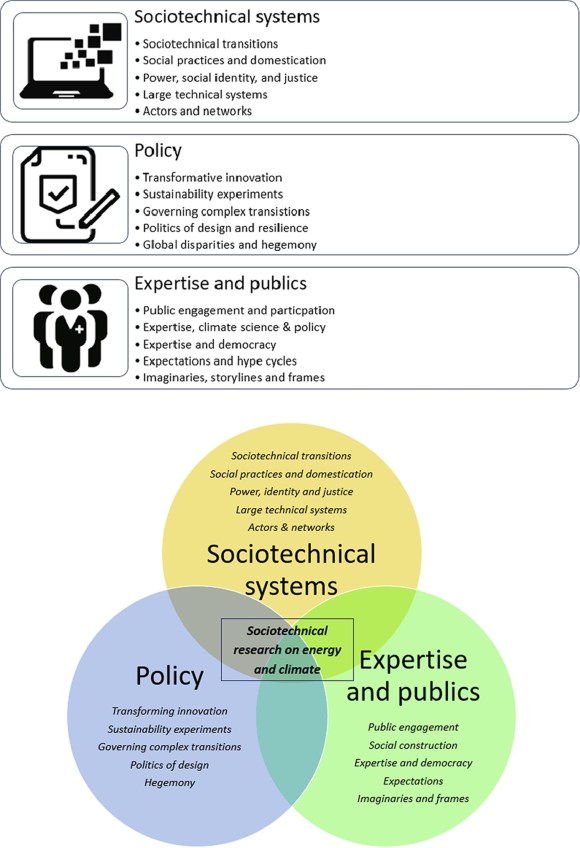
Benjamin K. Sovacool, David J. Hess, Sulfikar Amir, Frank W. Geels, Richard Hirsh, Leandro Rodriguez Medina, Clark Miller, Carla Alvial Palavicino, Roopali Phadke, Marianne Ryghaug, Johan Schot, Antti Silvast, Jennie Stephens, Andy Stirling, Bruno Turnheim, Erik van der Vleuten, Harro van Lente, and Steven Yearley, “Sociotechnical Agendas: Reviewing Future Directions for Energy and Climate Research,” Energy Research & Social Science, 70 (December 2020): 1-35.

Busytown’s challenges are our own—its inequalities, instabilities, infections, and unsustainabilities—rooted in the design and organization of its webs of techno-human systems.

Clark A. Miller, “A World Made by Belief,” Issues in Science and Technology. April 30, 2020. 
Categories
Uncategorized

Solar Tomorrows

Techno-humanity is staring down a once-in-a-century opportunity. Over the next three decades, it now looks increasingly certain that the inhabitants of earth will do the hard work of ripping out the beating industrial heart that powers the global economy and replacing it with more sustainable energy alternatives. Here’s the thing, though. That effort is not just an exercise in swapping out our choice of fuels or replacing one set of technological systems that produce, distribute, and consume energy with another. We are techno-humans. We live in petrocultures and carbon democracies and automobile societies. Altering these realities is as much a project in human re-engineering as it is technological re-engineering. As we imagine, design, and build new energy systems grounded in carbon-free technologies, we kinda also want to ask: what kind of photoncultures and solar democracies are we imagining, designing, and building along the way. And, at least as some of us are approaching it, we want to inquire into our design options and to open up deliberation about those options to wider and more inclusive groups of techno-humans than we have in the past. That’s the central motivation behind the Solar Tomorrows project. Join us in imagining just how flexible and awesome a tool the humble solar cell can be as an instrument for imagining and building more inclusive futures that truly do belong to everyone.

Solar-Powered Societies

This collection was inspired by a simple question: what would a world powered entirely by solar energy look like? In part, this question is about the materiality of solar energy—about where people will choose to put all the solar panels needed to power the global economy. It’s also about how people will rearrange their lives, values, relationships, markets, and politics around photovoltaic technologies. 

Coming soon!

To imagine the post-carbon city entails inquiry into far more than the technologies that will power its diverse activities. It requires exploring what carbon neutrality will mean for the people who live in the cities of the future and wander their boulevards and alleyways. The stories, essays, and art in this collection explore the challenges, opportunities, and irreducible complexities of transitioning our cities away from carbon-intensive fossil fuels and toward a clean, renewable energy economy.

Socio-Energy Systems Design

Through time, energy policy choices reconfigure societies, even as societies reconfigure energy systems, especially at moments when new energy systems are brought into being or during periods when existing systems are significantly rearranged through the persistent evolution, growth, and embedding of energy into human affairs.

Clark A. Miller, Jennifer Richter, and Jason O’Leary, “Socio-Energy Systems Design: A Policy Framework for Energy Transitions,” Energy Research and Social Science 6:29-40. 2015.

Techno-Human Transitions

Energy is a harbinger for a new era in human history. We are now moving from an era of constructing large-scale technologies to one of re-constructing complex, socio-technological systems that link energy to a wide range of other systems such as water, transportation, food production, and housing. This transition will challenge engineers, societies, policy-makers, and the social and policy sciences to develop new approaches to innovation that integrate both technological and human dimensions together.

Clark A. Miller, Alastair Iles, and Christopher Jones, “The Social Dimensions of Energy Transitions,” Science as Culture 22(2): 135-148. 2013.